
Sales & Operations Planning
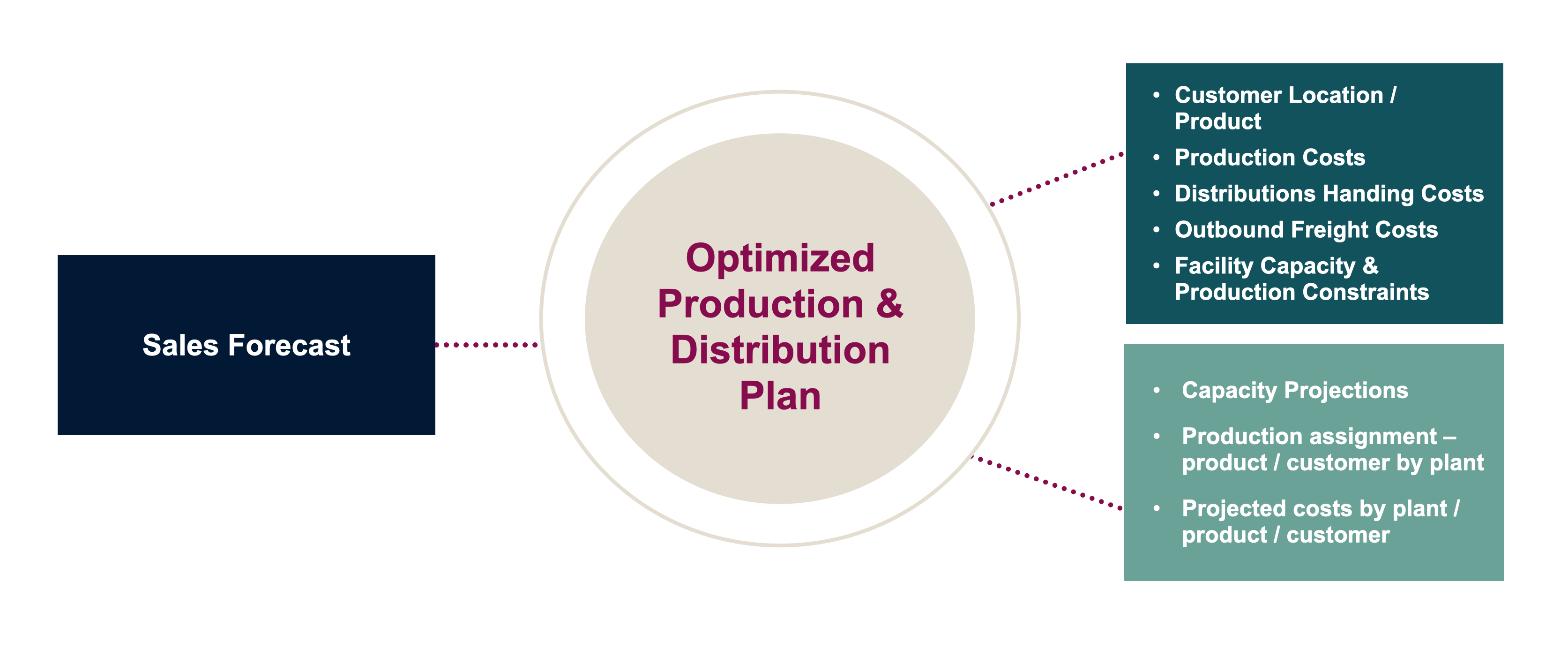
Taking into account your sales forecast, we analyze location, production, and distribution factors to create a production and distribution plan to overcome your supply chain challenges.
What Is Sales & Operations Planning? permalink
Sales and operations planning (S&OP) is an integrated business management process that aligns your sales forecast with your operational capacity — production schedules, inventory levels, and distribution plans — into a single, executable roadmap. Without it, sales teams make promises the supply chain cannot keep, and operations runs blind to where demand is actually heading.
An effective S&OP process breaks down the silos between commercial and operational functions. It creates a shared picture of demand, matches that picture to supply capacity, and produces a plan that finance, sales, and operations can all commit to.
Key Inputs We Analyze permalink
S&OP requires integrating data from across your organization:
- Sales forecast — Historical sales patterns, pipeline data, and market intelligence combine to produce a demand signal that drives the rest of the plan.
- Production capacity — We map current capacity against projected demand to identify where constraints will create fulfillment risk.
- Inventory position — Current stock levels, safety stock targets, and inventory carrying costs inform how much buffer the plan can rely on.
- Distribution network — Warehouse capacity, transportation lead times, and network routing determine how quickly supply can reach end customers.
- Supplier lead times — For purchased components and materials, supplier reliability and lead times shape how far ahead the plan must extend.
The S&OP Process We Follow permalink
We work with your team to build or improve a repeatable monthly S&OP cycle:
- Data gathering — Consolidate demand, supply, and financial data across business units
- Demand review — Validate and reconcile the sales forecast with input from commercial teams
- Supply review — Evaluate capacity against the demand plan; identify gaps and constraints
- Pre-S&OP meeting — Resolve issues at the functional level before executive review
- Executive S&OP — Present a balanced plan with options and trade-offs for leadership decision-making
Benefits of Effective S&OP permalink
Organizations that execute S&OP well consistently outperform those that do not:
- Fewer stock-outs and emergency orders
- Reduced excess and obsolete inventory
- Improved on-time delivery and customer service
- Better utilization of production and distribution assets
- Greater financial predictability across planning horizons